
The novel follows Pastor Herrmann and his family, whose peaceful life in the Swabian Alps is shattered by the regime. When Herrmann denounces the Nazis’ crimes from the pulpit, he becomes a target of the Gestapo. The terror reaches its peak when the authorities threaten to forcibly sterilize his gifted daughter, Rose, due to her short stature. The only person who can protect them is the shadowy Gestapo officer Hans Schwier—a man who harbors dangerous desires for Rose.
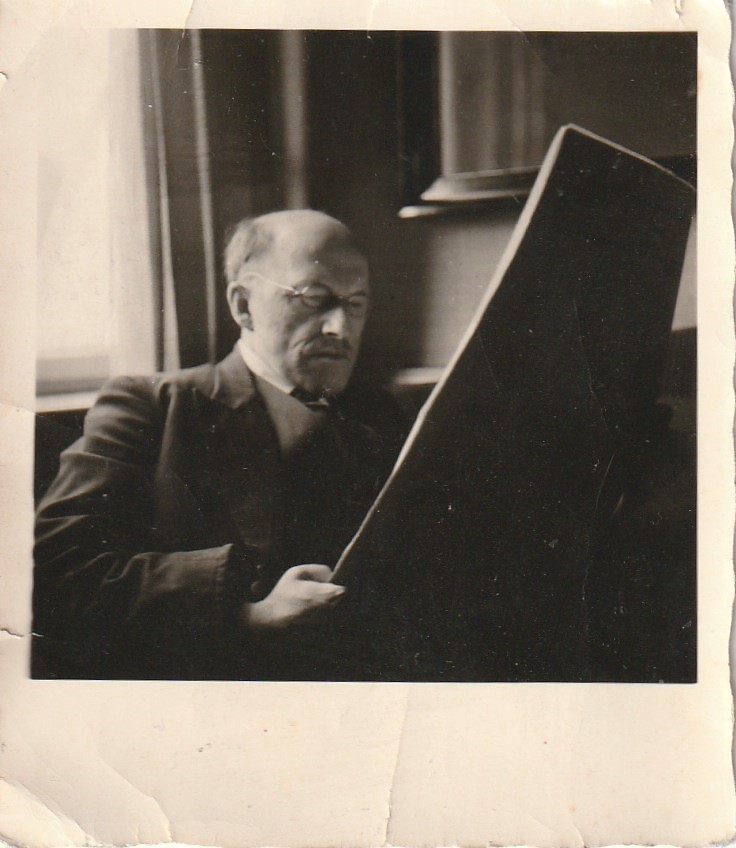
Pastor Herrmann was my grandfather.
He was no famous resistance fighter like Georg Elser or Claus von Stauffenberg. He was one of the small opponents of the regime—men and women whose resistance was largely erased after 1945. Even after the war, their persecution continued in different forms. In 1946, despite his opposition to the Nazis, my grandfather was put on trial as a „follower“ (Mitläufer) under the denazification laws. My novel also explores how the Third Reich did not simply end in 1945, but lived on in various ways.
Chapter 16 – a ChatGPT translation
Finally, summer vacation! Illmandingen smelled of freshly dried hay. In just a few days, Rose had lost her pale Tübingen complexion and taken on the tan of the village children. After a week outside, she was no different from them. She spent days helping with the hay, coming home sweaty and covered in chaff, feeling happier than she had in a long time.
Until they took Mariele.
That evening, Heiner walked her home after haying. They laughed and kicked clumps of earth along the path. Just before they reached Heiner’s farm, he grabbed her arm and made her stop. His mouth hung open as he pointed ahead. A boxy vehicle stood parked in front of the stable. Rose followed his gaze.
The van was white, with frosted windows that concealed the inside. A red cross was painted on the glass. Was someone sick? An emergency? Heiner nudged her. She was looking in the wrong direction. He pointed at the house entrance. Rose’s stomach clenched.
Two nurses in long white aprons and caps were dragging Mariele out of the house. Mariele clung to the doorframe. Then a man in a blue uniform grabbed her from behind. She kicked and screamed. The nurses held her by the arms and pulled. The man shoved from behind. Their mother appeared in the doorway, holding a small cardboard suitcase.
Why wasn’t she stopping them? Why wasn’t she protecting Mariele? Something was wrong. Where were they taking her? Rose’s mind raced. Did Mariele have a contagious disease? Did they need to isolate her?
Rose couldn’t make out the faces clearly, but she saw enough to notice the mother’s expression. It was blank. Empty. Mariele, however, screamed like an animal being led to slaughter. Poor Mariele! Rose wanted to run to her, but Heiner held her arm so tightly it hurt. „Stay back!“ he whispered. „Or they’ll take us too.“ They ducked behind the fence.
Through the gaps in the wire, they watched as Mariele was forced into the back of the van. They strapped her down with thick brown leather belts. Though small, she fought so hard that all three had to restrain her.
The man climbed out, slammed the doors shut with a dull thud. Mariele’s screams still pierced through. They heard her wailing until the engine roared to life and the van rumbled away.
Heiner and Rose stood up, watching it disappear. The mother watched too but only for a moment. Then she turned, stepped inside, and slammed the door behind her.
Heiner hesitated, running his hand over the wire mesh.
„What’s wrong with Mariele?“ Rose demanded.
He didn’t answer immediately. She pressed him. „You know something!“
Heiner shrugged, sighed, then finally muttered, „My sister is ‘genetically unfit.’“
„What?“ Rose felt cold despite the summer heat.
Heiner burst into tears, suddenly shouting, „Mariele’s a moron! Everyone knows it!“
Rose’s heart pounded. „But Mariele is Mariele. She understands everything. She plays with us. She helps on the farm. She just isn’t good in school.“
„They pulled her out of second grade,“ Heiner admitted. „Teacher Specht said she couldn’t keep up. Called her completely useless.“
„But…“ Rose’s throat tightened. „That doesn’t mean they had to take her like that…“ Tears stung her sunburned cheeks. „What will they do to her?“ she whispered.
Heiner shrugged again. „I don’t know,“ he said. „But if I misbehave, I’ll end up in Grafeneck too.“ His voice cracked. „That’s what my mother said.“
Rose felt sick. „What happens there?“
„It’s an institution. For lunatics. And those who don’t fit.“ His voice was uncertain.
Rose pressed him. „And what will they do to Mariele there?“
Heiner yelled, „How should I know?!“
The way they had taken Mariele, by force, told them both that something terrible awaited her.
Heiner barely said goodbye. He shuffled toward his house, shoulders slumped, as if bracing for punishment.
Rose ran into her father’s study without knocking. She rushed past Lina without a word.
„They took Mariele!“ she cried.
Her father jumped up from his book. A startled „Oh!“ escaped his lips. Then another, longer and heavier, „Oh.“
Rose was burning, feverish with anger. „They hurt her! They dragged her away!“
Her father stepped toward her but stopped a meter away. He slammed his book to the floor and stomped. „Those wicked people!“ he shouted. „Dogs!“
Rose looked at him pleadingly. She needed answers. She needed to understand what was happening.
He raged for a moment, then flung open the window, breathing deeply, trying to calm himself. Finally, he explained, „The new teacher, Specht, removed Mariele from school in spring. He claimed she was beyond help. Then he reported her to the new so-called ‘Genetic Health Court.’“
Rose stared at him. „What is that?“
His voice turned hoarse. „The criminals who run our country passed a law last summer to prevent ‘genetically ill offspring.’ Now these courts exist. Doctors, asylum directors, even teachers can report people they believe shouldn’t have children.“ He lowered his head. „Mariele’s wretched mother kept pestering the teacher about what to do with her. She said a child without schooling was worthless. So he suggested sterilization. Because Mariele was deemed ‘racially undesirable.’“ He hesitated, then added carefully, „They will treat her in a hospital.“
„Treat her?“ Rose gasped.
„So she can never have children.“ Her father’s glasses fogged up. He removed them and wiped them with his handkerchief.
„You should have seen how they took her! She fought with everything she had! She was terrified!“
Her father put his glasses back on. „It is bodily harm of the worst kind. They will traumatize her. Mariele won’t understand the violence they are inflicting on her. She is defenseless. I found out too late. I couldn’t stop it.“
Rose stepped forward and wrapped her arms around his waist, burying her face in his shirt. Tears soaked the fabric. He hesitated, his arms stiff at his sides. After a few seconds, he finally embraced her gently.
Lina stood frozen in the doorway. Her wailing filled the house: „Oh, poor Mariele! That little angel! Poor, poor Mariele!“

 Olivia Kleinknecht - Autorin
This novel will challenge you; it resonates far beyond its historical setting. When your society becomes increasingly evil and authoritarian, how can you behave ethically? Not everyone can sail away to friendlier shores. Direct opposition is dangerous, not only for you but also for those close to you. The regime demands your allegiance — how can you protect your family from harm while not giving in?
LikeGefällt 1 Person